After servicing thousands of St. Cloud homes, we've seen the same installation mistakes drain homeowners' wallets year after year. St. Cloud's 110-degree temperature swing—from -20°F winters to 90°F humid summers—exposes every shortcut. Undersized units struggle through January cold snaps. Oversized systems short-cycle during July humidity. Most failed installations trace back to skipped steps, not faulty equipment.
This guide shares the specific mistakes we encounter most frequently in Stearns County homes and the questions that help you avoid them. You'll learn why rushed load calculations, improperly sized ductwork, and permit shortcuts turn 15-year systems into 7-year headaches—and how to spot contractor red flags before work begins. Your HVAC system is a significant investment. The right installation approach protects it.
Quick Answers
HVAC Installation in St. Cloud
HVAC installation in St. Cloud requires a contractor licensed with the city, a $25,000 mechanical bond filed with St. Cloud DLI, and permits for all work.
What to expect:
Cost: $5,000–$15,000 depending on system and ductwork
Timeline: 1-3 days plus 1-2 weeks for city inspection
Climate factor: St. Cloud's 110°F temperature swing demands precise sizing
What separates good installations from bad:
Manual J load calculation performed (not optional)
Existing ductwork inspected and sealed
Permits pulled and inspections completed
Available rebates:
State: Up to $8,000+
Utility: Additional incentives for high-efficiency equipment
Federal: Up to $2,000 for heat pumps
Our recommendation: Verify contractor credentials before requesting quotes. The installer matters more than the equipment brand. A properly sized, correctly installed system lasts 15-20 years. A rushed installation becomes a 7-year problem.
Top Takeaways
The installer matters more than the equipment. A mid-tier system installed correctly outperforms a premium system with shortcuts.
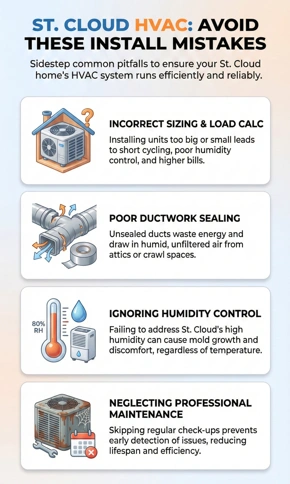
Skipped load calculations cause the most expensive problems. 31% of systems are oversized because contractors guessed. The math takes an hour. The consequences last 15+ years.
Duct issues waste up to 37% of efficiency. Leaky ductwork loses conditioned air before it reaches your rooms. Fix it during installation—not after.
Permits protect your investment. Unpermitted work voids warranties and skips safety inspections. Licensed contractors pull permits without hesitation.
Claim available rebates. State, utility, and federal incentives add up to thousands. Verify eligibility before signing any contract.
Critical Installation Errors That Cost St. Cloud Homeowners the Most
Skipping the Manual J load calculation ranks as the most expensive mistake we see. This calculation determines exact heating and cooling requirements based on your home's square footage, insulation levels, window placement, and local climate data. Without it, contractors guess—and guessing in St. Cloud's extreme climate leads to equipment that's either too small to keep up or too large to run efficiently. We've replaced systems less than five years old simply because no one ran the numbers before installation.
Ductwork problems come in a close second. Leaky ducts, improper sizing, and poorly planned layouts waste 20-30% of conditioned air before it reaches living spaces. In older St. Cloud homes, we frequently find new high-efficiency units connected to decades-old ductwork that was never designed for modern airflow requirements. The equipment works harder, runs longer, and fails sooner. Sealing and right-sizing ductwork during installation costs far less than the energy losses and repairs that follow when it's ignored.
Permit and inspection shortcuts create the most serious long-term consequences. Unpermitted work voids manufacturer warranties, complicates home sales, and misses code violations that affect safety and performance. Licensed contractors pull permits without hesitation because proper inspections protect everyone. If a contractor suggests skipping this step to save time or money, consider it a major red flag.

"In 25 years of HVAC work in St. Cloud, I've never seen a properly sized system with sealed ductwork fail prematurely—but I've replaced hundreds of units that were installed without a load calculation. The math matters more than the brand name on the box."
Essential Resources for St. Cloud HVAC Installation Success
Getting your HVAC installation in St. Cloud right the first time protects your investment—and your comfort. These resources help you verify contractors, understand local requirements, and maximize every rebate dollar available to St. Cloud homeowners.
1. Check Local Permit Requirements Before Any Work Starts
St. Cloud requires permits for HVAC installation, and your contractor should handle this—no exceptions. This official city resource confirms licensing requirements and helps you verify your contractor is approved to work locally. Skipping permits can void your warranty and create headaches when you sell.
Resource: City of St. Cloud – Heating/Ventilation Permits https://www.ci.stcloud.mn.us/148/Heating-Ventilation-Projects
2. Verify Your Contractor's Bond Status in Minutes
St. Cloud requires all HVAC contractors to file a $25,000 mechanical bond. Skip the guesswork—this free state lookup tool shows bond status, certifications, and any enforcement actions before you sign anything.
Resource: Department of Labor and Industry – License Lookup https://www.dli.mn.gov/license-and-registration-lookup
3. Unlock Up to $8,000 in State Energy Rebates
St. Cloud's Save Energy program combines federal and state incentives for qualifying HVAC upgrades. Rebate amounts depend on energy savings achieved and household income. Don't leave money on the table—check eligibility before your installation.
Resource: Department of Commerce – Save Energy https://mn.gov/commerce/energy/consumer/energy-programs/save-energy-mn.jsp
4. Understand Efficiency Ratings Before Your First Estimate
SEER, AFUE, HSPF—these numbers matter more than brand names when it comes to long-term savings. The EPA's guide breaks down efficiency ratings in plain language so you can evaluate contractor recommendations with confidence.
Resource: ENERGY STAR – Guide to Energy-Efficient Heating and Cooling https://www.energystar.gov/sites/default/files/asset/document/HeatingCoolingGuide%20FINAL_9-4-09_0.pdf
5. Research Contractor Reviews and Complaint Histories
Good work leaves a trail of happy customers. BBB profiles show accreditation status, ratings, and how companies respond to complaints—patterns that online reviews alone might miss.
Resource: Better Business Bureau – HVAC Contractors https://www.bbb.org/us/mn/minneapolis/category/heating-and-air-conditioning
6. Stack Utility Rebates for Even Bigger Savings
Your utility company offers additional rebates for high-efficiency heating systems, duct sealing, and weatherization. Combine these with state programs and you're looking at serious savings on your installation.
Resource: Energy Resources – Home Rebates and Programs https://www.minnesotaenergyresources.com/savings/rebates
7. Maximize Federal Tax Credits—Up to $3,200 Annually
The Inflation Reduction Act offers substantial tax credits for qualifying HVAC equipment. This guide explains eligibility, stacking strategies, and how to time projects across multiple years for maximum benefit.
Resource: Center for Energy and Environment – IRA FAQs https://www.mncee.org/inflation-reduction-act-faqs
Supporting Statistics
These federal numbers match what we see in St. Cloud homes every week. Installation quality determines whether your system performs as promised—or drains your wallet.
52% of household energy goes to heating and cooling.
The U.S. Energy Information Administration confirms what our service calls reveal: HVAC dominates home energy use.
In St. Cloud's climate, we've seen that percentage climb even higher when installation problems exist.
Improper sizing increases runtime
Ductwork issues force systems to work harder
Homeowners feel it in utility bills—month after month
Source: U.S. Energy Information Administration https://www.eia.gov/energyexplained/use-of-energy/homes.php
37% average cooling efficiency loss from duct leakage.
This U.S. Department of Energy finding matches what we encounter in older Stearns County homes.
We've tested systems where homeowners assumed equipment failure—only to discover ductwork losing a third of conditioned air before reaching living spaces.
What proper duct sealing delivers:
Up to 44% reduction in cooling usage
Lower peak energy demand
Thousands saved in wasted energy and future repairs
Source: U.S. Department of Energy https://www.energy.gov/eere/buildings/articles/residential-hvac-installation-practices-review-research-findings
31% of HVAC systems are oversized.
The DOE analyzed nearly 5,000 home energy audits. Almost one-third of systems were larger than necessary—because contractors skipped load calculations.
That tracks with what we've documented locally. Oversized equipment causes:
Short-cycling and uneven temperatures
Excess humidity in summer
Premature equipment failure
Higher energy costs
We've replaced units less than five years old simply because no one ran the numbers. The math takes an hour. The consequences last the life of the system.
Source: U.S. Department of Energy https://www.energy.gov/eere/buildings/articles/residential-hvac-installation-practices-review-research-findings
Final Thoughts
After decades of HVAC work in St. Cloud, we've learned one thing above all else: the installation matters more than the equipment.
Homeowners often focus on brand names, efficiency ratings, and upfront costs. Those factors matter—but they're secondary. A premium system installed poorly will underperform a mid-tier system installed correctly. Every time.
The mistakes we've covered aren't rare. They're the norm:
31% of systems oversized
37% efficiency losses from duct issues
Countless units failing years ahead of schedule
The biggest risk isn't choosing the wrong equipment. It's choosing the wrong installer.
A qualified contractor:
Runs Manual J calculations without being asked
Inspects existing ductwork before quoting
Pulls permits because that's what professionals do
St. Cloud's 110-degree temperature swing between January and July exposes every installation flaw. Systems that "seem fine" in October reveal problems in February at -15°F.
Our advice before signing any contract:
Verify credentials. Use the state license lookup. Check BBB profiles. Confirm the $25,000 mechanical bond is active.
Ask about load calculations. If they quote a system size before measuring your home—walk away.
Claim available rebates. State programs, utility incentives, and federal tax credits add up to thousands.
Get the permit. No exceptions. Unpermitted work voids warranties and puts your family at risk.
Your HVAC system protects your home's comfort for 15-20 years when installed right. It becomes a 7-year headache when installed wrong.
The difference comes down to who does the work.
Next Steps
Ready to move forward? Here's exactly what to do—and in what order.
1. Verify Contractor Credentials
Before requesting quotes:
Check bond status
Verify city licensing
Review BBB ratings and complaints
2. Request Multiple Quotes
Get at least three written estimates. Compare more than price.
Look for:
Manual J load calculation included
Ductwork inspection and recommendations
Permit costs itemized
Equipment and labor warranty terms
3. Ask the Right Questions
During consultations, confirm:
Will you perform a Manual J load calculation?
How will you evaluate existing ductwork?
Are permits and inspections included?
What voids the equipment warranty?
How long have your installers worked in St. Cloud?
4. Research Available Rebates
Identify every incentive you qualify for:
State
Utility
Federal
If your contractor doesn't mention rebates—ask why.
5. Review the Contract
Before signing, confirm it includes:
Exact equipment model numbers
Load calculation documentation
Permit responsibility assigned to contractor
Project timeline and payment schedule
Warranty terms in writing
6. Schedule Strategically
Best timing: Spring or fall when demand is lower
Typical installation: 1-3 days
Inspections: Allow 1-2 weeks for city scheduling
7. Prepare for Installation Day
Clear 3-foot access around indoor/outdoor units
Ensure attic or basement access is unobstructed
Secure pets
Plan for 4-8 hours without heating or cooling
FAQ on "HVAC Installation in St. Cloud"
Q: How much does HVAC installation cost in St. Cloud?
A: Most complete installations run $5,000 to $15,000. The range depends on:
System type and efficiency rating
Home size and layout
Existing ductwork condition
We've seen lowball bids exclude load calculations, permits, and duct sealing. The cheapest estimate often becomes the most expensive project.
Get at least three written quotes. Compare what's included—not just the bottom line.
Q: Do I need a permit for HVAC installation in St. Cloud?
A: Yes. The City of St. Cloud requires permits for any installation, replacement, or alteration.
What happens when permits get skipped:
Manufacturer warranties voided
Liability issues during home sales
Safety inspections missed
Your contractor should handle permits automatically. In 25 years across Stearns County, we've never met a legitimate contractor who hesitates. If yours suggests skipping—find a different contractor.
Q: How long does HVAC installation take in St. Cloud?
A: Most installations take 1-3 days.
Furnace or AC replacement: 1 day
Full system with ductwork modifications: 2-3 days
City inspection scheduling: Add 1-2 weeks
We recommend spring or fall installations. Our crews aren't juggling emergency calls during extreme weather, and scheduling moves faster.
Q: What HVAC system size do I need for my St. Cloud home?
A: We don't know until we run the numbers. A Manual J load calculation factors in:
Square footage
Insulation levels
Window placement
Ductwork condition
St. Cloud climate data
Any contractor who quotes size before measuring is guessing. We've replaced units less than five years old because someone skipped this step.
The calculation takes one hour. Insist on it.
Q: Are there rebates available for HVAC installation in St. Cloud?
A: Yes—and homeowners consistently leave money on the table.
Available incentives:
State: Up to $8,000+ through Save Energy St. Cloud
Utility: St. Cloud Energy Resources rebates for equipment and duct sealing
Federal: Up to $2,000 for heat pumps, $600 for furnaces
We help customers navigate these programs. A good contractor brings this up without being asked.
Check eligibility before signing any contract.
Here is the nearest branch location serving the Miami Beach FL area…
Filterbuy HVAC Solutions - Miami FL
1300 S Miami Ave Unit 4806, Miami, FL 33130
(305) 306-5027