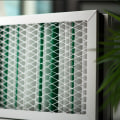
16x22x4 MERV 13 Air Filters Guide for Allergies and Asthma
I've spent enough time around HVAC systems and filter slots to know that most people don't think about their air filter until someone in the house starts sneezing every morning. Here's the pattern I keep running into: it's rarely the filter itself that's wrong; it's the size. People chase a higher MERV number before they've confirmed they're even ordering the right dimensions for their actual slot, and that mismatch is usually what quietly undermines the upgrade before it has a chance to work.
This guide walks through why a 16x22x4 MERV 13 filter is worth considering for allergy and asthma relief, how it compares to lower-rated options, and what to check before you make the switch.
TL;DR Quick Answers
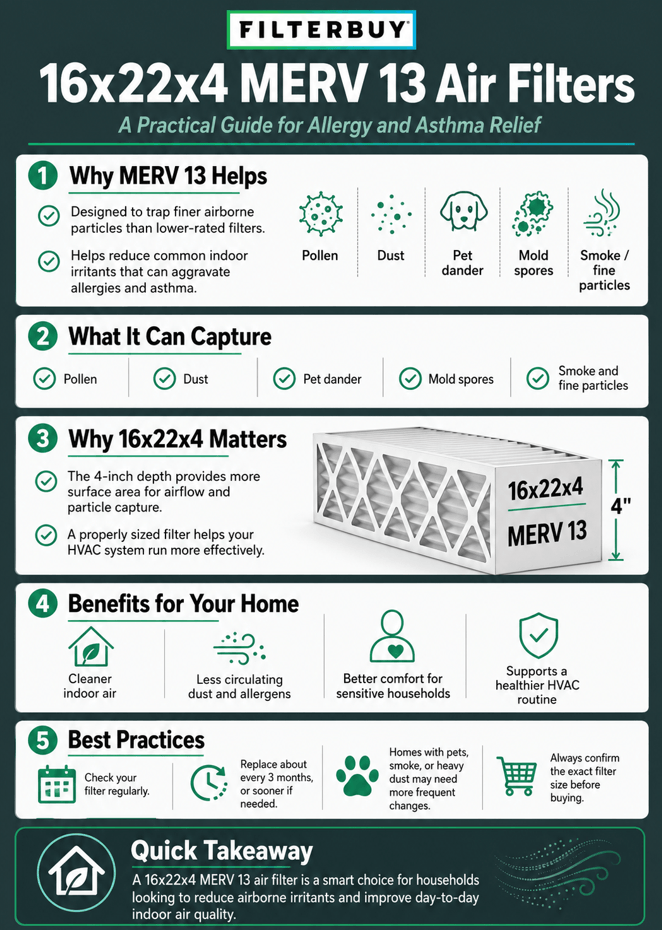
A 16x22x4 MERV 13 air filter is one of the most effective upgrades I recommend for households dealing with allergies or asthma, because it captures the fine particles that trigger symptoms without straining most modern HVAC systems. It fits standard 4-inch filter cabinets, typically lasts 3 to 6 months, and outperforms MERV 8 and MERV 11 filters on particle capture where it matters most. If your system supports it, this size and rating combination is worth the switch.
Top Takeaways
MERV 13 filters are rated to capture at least 50% of particles between 0.3 and 1.0 microns and 85% of particles between 1 and 3 microns, a range that includes pollen, pet dander, and mold spores.
The 4-inch depth of a 16x22x4 air filter allows for longer service life and better airflow than a thinner 1-inch filter at the same MERV rating.
Most modern residential HVAC systems can handle MERV 13, but older or undersized systems may need a quick compatibility check first.
Indoor air quality issues are often invisible until symptoms show up, and a properly sized, higher-rated filter is one of the lowest-effort fixes available.
Size-verified 16x22x4 air filters make it easier to confirm you're ordering the correct nominal size before you buy.
MERV 13 isn't a complete fix on its own. It won't correct duct problems, an undersized return, or symptoms driven mainly by outdoor air entering through open doors and windows.
Why MERV 13 Matters for Allergy and Asthma Symptoms
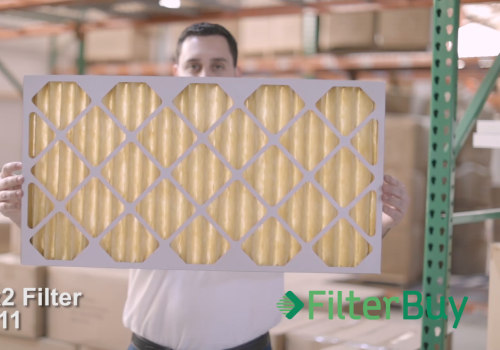
Not all air filters are built to catch the same particles. Lower-rated filters like MERV 8 mostly stop larger debris such as lint and dust. MERV 13 goes further, trapping the smaller airborne particles that tend to aggravate allergies and asthma, including pollen fragments, pet dander, mold spores, and fine dust.
I've found that this is usually the deciding factor for households where someone has ongoing respiratory sensitivity. What surprises most people isn't that MERV 8 fails; it's where it fails: dust and lint get caught just fine, but the fine fragments small enough to trigger symptoms- pollen fragments, dander, mold spores- sail right through. A jump from MERV 8 to MERV 13 isn't a marginal upgrade; it's a meaningful change in what actually gets pulled out of the air before it reaches your lungs. For a closer look at how filtration levels compare across sizes, our existing MERV 13 filter guide breaks down installation and upkeep in more detail.
Does 16x22x4 MERV 13 Restrict Airflow?
Not usually, as long as the filter is properly sized and your system is a reasonable match for it. This is the question I get asked most often, and it's a fair one. Higher MERV ratings mean denser filter media, which can increase resistance to airflow if a system isn't built for it.
In practice, the tell isn't a number on a spec sheet; it's what you notice in the first week after switching: a blower that runs longer than it used to, a faint whistle at the return grille, or rooms that take noticeably longer to reach temperature. Those are the signs I'd watch for before I'd trust any MERV rating printed on the box.
The 4-inch depth helps offset that concern. A thicker filter has more surface area than a 1-inch filter, which spreads out airflow resistance and reduces strain on the blower motor. Most systems manufactured in the last decade or so are designed to handle MERV 13 without issue, but I'd still recommend checking your system's specifications or asking your HVAC technician before upgrading, especially if your equipment is older or has a history of airflow problems. If you're not sure where your current filter even sits, finding your filter slot is the right place to start before you measure anything.
How 16x22x4 Compares to Nearby Sizes
No, 16x22x4 is not interchangeable with 16x20x4 or 16x25x4, even though the numbers look close enough to assume otherwise. Filter slots vary more than people expect, and a few inches in either direction changes everything. This is one of the sizes I see mixed up most often. Installing the wrong one creates gaps around the frame, which lets unfiltered air bypass the media entirely, and I've seen that gap alone undo the benefit of an otherwise correct MERV 13 upgrade.
Before ordering, I always suggest measuring your existing filter or the slot opening directly rather than relying on the size printed on your old filter. Nominal and actual dimensions don't always match, and that quarter-inch difference is the detail that gets missed when someone orders from memory instead of a tape measure.
Installing It the Right Way
Getting the size right solves half the problem. The other half is orientation, and it's the step I see skipped most often. Every 16x22x4 filter has an airflow direction printed on the frame, usually a small arrow along the cardboard edge, and it needs to point toward the furnace or air handler, not away from it.
I've pulled out more than a few filters that were doing almost nothing, not because the size or MERV rating was wrong, but because they'd been installed backward. The pleats seal against airflow differently depending on direction, so a reversed filter can restrict air on one side while letting more bypass the media on the other. If the arrow has worn off or was never visible, check your system's manual for the correct orientation rather than guessing, since it can vary slightly by cabinet design.
How Often to Replace a 16x22x4 MERV 13 Filter
A 4-inch MERV 13 filter typically lasts 3 to 6 months under normal conditions. Here's the part people don't expect: that longer lifespan is also its biggest trap. A 1-inch filter forces a monthly check just by being high-maintenance, but a 4-inch filter is easy to forget entirely, and by the time it's visibly dirty, it's often been underperforming for weeks already. I'd still tighten the schedule in a few situations, and it helps to know the signs of a clogged filter before they turn into bigger problems:
Homes with pets, where dander accumulates faster
Households with allergy or asthma sufferers, where filter buildup directly affects symptom control
Areas with high pollen counts or nearby construction
A filter that looks clean can still be underperforming, so setting a reminder rather than waiting for visible dust buildup is the more reliable approach.
It's also worth judging by monthly cost rather than sticker price alone. A 4-inch filter costs more upfront than a 1-inch equivalent, but since it lasts roughly three to six times as long, the cost per month of actual use often works out comparable, sometimes lower, once you factor in how often you'd otherwise be buying and replacing a thinner filter.
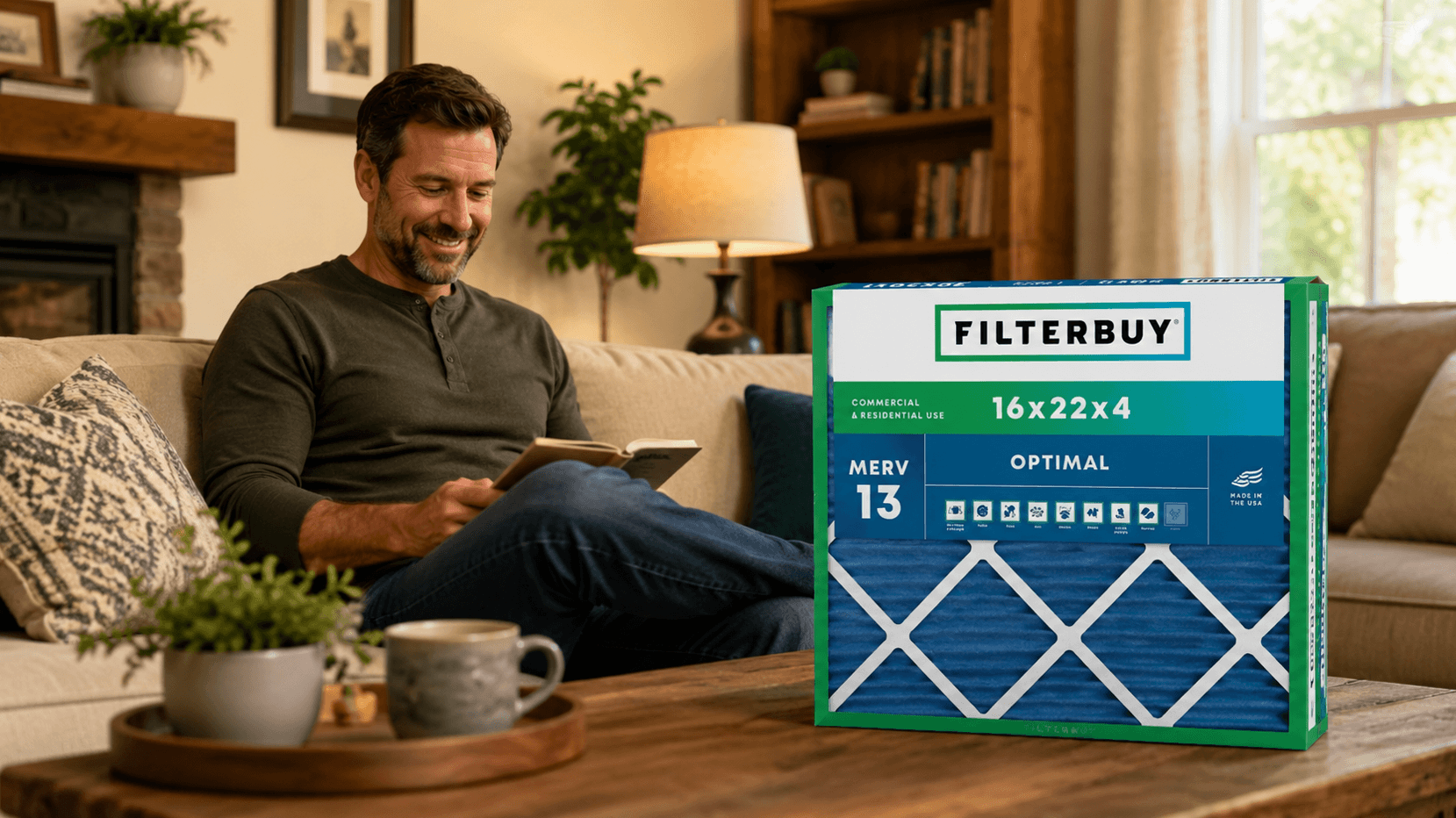
“In the field, the households getting real relief aren't the ones with the highest MERV number; they're the ones whose rating actually matches what their system can move air through. That's the detail most people skip, and it's usually why a filter quietly does its job instead of getting pulled six weeks later because the system started running loud.” - Terrence Mowles
Essential Resources for Choosing the Right 16x22x4 Air Filter
Know Your MERV Number Before You Buy
Every MERV rating from 1 to 16 captures a different range of particle sizes, and picking the wrong one means paying for filtration your system either can't use or doesn't need. This chart breaks down exactly what each MERV level traps, which is the fastest way to confirm MERV 13 is the right call for a 16x22x4 slot.
Source: What is a MERV rating? – U.S. EPA
Confirm MERV 13 Is the Efficiency Federal Health Agencies Actually Recommend
It's one thing for a filter box to claim high performance, and another for a federal health agency to publish the exact capture percentages. This resource confirms MERV 13's real-world efficiency at trapping the particle sizes that matter most for indoor air.
Source: Ventilation FAQs – CDC/NIOSH
See the Engineering Standard Behind the Rating
The MERV scale isn't marketing; it's a testing method built by the organization that sets HVAC engineering standards worldwide. Understanding who developed the rating system, and why, makes it easier to trust the number printed on the filter box.
Source: Filtration / Disinfection – ASHRAE
Look for Certified, Allergy-Tested Options
Not every filter marketed for allergies has actually been tested for that claim. This certification program independently verifies which air filters meet strict, science-based standards for reducing asthma and allergy triggers.
Source: AAFA's Certification Program – Asthma and Allergy Foundation of America
Learn How Filter Choice Affects Your Energy Bill
A dirty or mismatched filter doesn't just hurt air quality; it forces the whole system to work harder and drives up utility costs. This guide lays out how often to check and change a filter to keep both airflow and energy use in check.
Source: Heat & Cool Efficiently – ENERGY STAR
Get the Installation Right the First Time
A correctly sized filter still underperforms if it's installed in the wrong spot or without a proper seal. This resource walks through where filters belong in a ducted system and how to avoid the bypass gaps that let unfiltered air through.
Source: HVAC Proper Installation of Filters – U.S. Department of Energy
Avoid Overpaying or Falling for Sales Pressure
Filter and HVAC purchases are a common target for high-pressure sales tactics and inflated efficiency claims. This consumer guide explains what to check before buying, including energy labels and how to spot a scam before it costs you.
Source: How To Save Money on Heating and Cooling Your Home – Federal Trade Commission
By the Numbers
MERV 13 captures a meaningful share of allergy-triggering particles. According to CDC/NIOSH guidance, a MERV 13 filter is at least 50% efficient at capturing particles between 0.3 and 1.0 microns and 85% efficient at capturing particles between 1 and 3 microns, a size range that covers most common allergens.
Indoor air is often more polluted than outdoor air. The EPA notes that indoor air pollutant concentrations can run 2 to 5 times higher than typical outdoor concentrations, which is part of why filtration inside the home matters as much as, if not more than, outdoor air quality.
Allergic rhinitis carries a real financial cost. NIH-published research puts the total direct medical cost of allergic rhinitis in the U.S. at approximately $3.4 billion per year, which is why symptom-reducing steps like proper filtration aren't just a comfort upgrade.
When MERV 13 Might Not Be the Right Call
I don't think MERV 13 is the right recommendation for every household, and I'd rather say that outright than oversell it.
Older systems with a single-stage blower that already struggles with airflow. Adding a denser 4-inch MERV 13 filter can strain a motor that wasn't built for it. A professional airflow check and possibly a lower rating is the safer starting point.
Homes where the return duct itself is undersized or leaky. That bottleneck happens before the air ever reaches the filter, and no MERV rating fixes a duct problem.
Anyone expecting the filter alone to solve seasonal outdoor allergies. A MERV 13 filter only cleans air that's already inside your home. Reducing outdoor air infiltration on high-pollen days- closed windows, sealed doors- makes more of a difference than the filter rating by itself.
A filter is one part of a larger indoor air picture, not a stand-alone fix. If your system can't reliably support MERV 13, or your symptoms are driven mostly by what comes in when doors and windows open, the size and rating covered in this guide won't be the full answer on their own.
Final Thoughts and Opinion
I don't think filter choice gets the attention it deserves. People will spend real money on a new HVAC system and then grab whatever filter is cheapest and closest to the right size, without checking either the fit or the rating. I understand why: the filter is the cheapest, least visible part of the whole system, so it's the part that gets the least scrutiny, right up until someone's symptoms don't improve and they can't figure out why.
For allergy- and asthma-affected households specifically, I think MERV 13 is the right baseline, not the ceiling. It's the point where filtration performance and system compatibility both land in a reasonable place for most residential setups. Going lower leaves allergens in circulation. Going much higher without confirming compatibility can strain a system that wasn't built for it.
If you're dealing with ongoing symptoms and haven't looked at your filter setup in a while, this is one of the more overlooked, lower-cost places to start.
Frequently Asked Questions
Will a MERV 13 filter fit any 4-inch filter cabinet?
Not automatically. MERV 13 media is denser, so the filter frame still needs to be sized correctly for your specific cabinet. A 16x22x4 filter fits a 16x22x4 slot, not a similarly sized neighbor.
Is MERV 13 overkill if my allergies are mild?
Not necessarily. Even mild symptoms often improve with better filtration, and the airflow tradeoff is minimal in most modern systems. If your symptoms are severe, MERV 13 is generally considered a meaningful step up from MERV 8 or 11.
Can a MERV 13 filter help with pet allergies specifically?
Yes. Pet dander falls within the particle range MERV 13 filters are rated to capture at a high rate, which is why it's a common recommendation for pet-owning households with allergy concerns.
How do I know if my HVAC system can handle MERV 13?
Check your system's manufacturer specifications or ask your HVAC technician. Systems with variable-speed blowers generally handle higher MERV ratings better than single-speed systems.
Glossary
MERV (Minimum Efficiency Reporting Value): A rating scale from 1 to 16 developed under ASHRAE testing standards that measures how effectively an air filter captures particles of different sizes. Higher numbers indicate finer particle capture.
MERV 13: A mid-to-high efficiency filter rating capable of capturing a majority of particles in the 0.3 to 3 micron range, including many common allergens.
16x22x4: A nominal air filter size describing a filter approximately 16 inches wide, 22 inches long, and 4 inches deep. Actual dimensions may vary slightly from the nominal size printed on the filter frame.
Air filter cabinet: The housing within an HVAC system that holds the air filter in place. Filter depth (1-inch, 2-inch, 4-inch, etc.) must match the cabinet's design.
Learn more about HVAC Care from one of our HVAC solutions branches…
Filterbuy HVAC Solutions - West Palm Beach FL
1655 Palm Beach Lakes Blvd., Ste 1005 West Palm Beach, FL 33401
(561) 448-3760
https://maps.app.goo.gl/VarpgNZnxuPQuW8A7